Investor vs First-Home Buyer: Investors Are Winning Australia’s Property Market
Source: SMH, Australian Bureau of Statistics, Cotality, AMP Capital
Australia’s housing market is becoming a battle between investors and first-home buyers.
Right now, the scoreboard clearly shows investors in the lead.
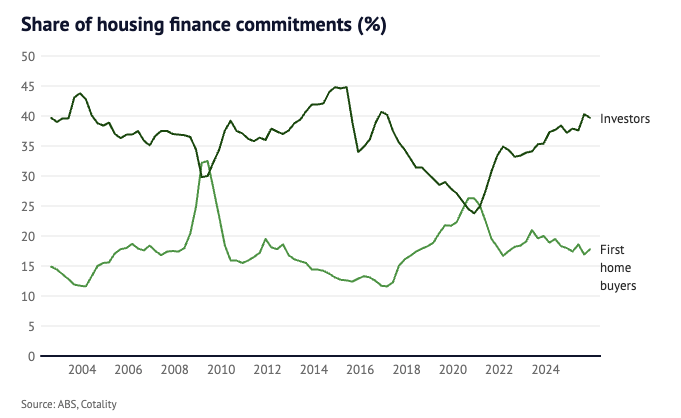
According to recent housing finance data, property investors accounted for 39.7% of all housing loans in the December 2025 quarter, worth about $43 billion.
First-home buyers?
Only 17.8% of loans, worth $19.3 billion.
Just five years ago, the situation was very different — first-home buyers actually had a larger share than investors.
So what happened?
Why Investors Are Winning
The reason is simple: investors follow opportunity.
When property prices rise and borrowing conditions improve, investors move quickly to secure assets before prices climb further.
Over the past few years, three key factors pushed investors back into the market.
1. Capital Growth Is Back
Investors chase capital growth.
When home values started rising again after the pandemic slowdown, investors quickly returned.
Unlike owner-occupiers who buy for lifestyle reasons, investors focus on returns.
If prices are rising — investors buy.
2. Investors Have Fewer Restrictions
First-home buyers often face limits such as:
Government scheme price caps
Smaller borrowing capacity
Lower deposits
Investors, on the other hand, have far more flexibility.
They can buy:
Entry-level homes
Mid-range properties
Premium assets
This means investors often compete directly with first-home buyers — especially in the affordable segment of the market.
3. Investors Move Faster
When uncertainty hits the market, investors step back.
But once confidence returns, they come back fast.
During COVID-19 in 2020, many investors stayed on the sidelines.
Once interest rates dropped and property prices started climbing, investors returned in force.
By late 2025, investor loan numbers had surged again.
Government Is Trying to Help First-Home Buyers
To rebalance the market, the government expanded the 5% Deposit Scheme in October 2025.
This allows eligible buyers to:
Purchase a home with just a 5% deposit
Avoid paying Lender’s Mortgage Insurance
Access higher price caps in certain locations
Early data shows more enquiries and loan approvals from first-home buyers.
But the full impact may take time.
Why Competition Is So Intense
The biggest challenge is that investors and first-home buyers are chasing the same properties.
Affordable houses and entry-level units are attractive to both groups.
And investors have a key advantage:
they are not restricted by government scheme price caps.
This means they can compete across a wider range of properties.
What Happens Next?
Experts believe the market could shift again over the next 12 months.
Two factors will determine who wins the next round:
1. The success of the 5% deposit scheme
If more buyers enter the market, first-home buyer numbers could rise.
2. Interest rates
Higher rates tend to slow investors because borrowing becomes more expensive.
But historically, once investors see strong price growth again, they tend to return quickly.
The Reality of Australia’s Property Market
The data shows one clear truth:
Property cycles are often driven by investors.
When investors see opportunity, they move fast — and they move in large numbers.
For first-home buyers, this means entering the market often requires:
Careful timing
Strong borrowing capacity
Government support programs
Final Thought
The battle between investors and first-home buyers will always shape Australia’s housing market.
Right now, the numbers show investors firmly ahead.
But if government incentives and interest rates shift the balance, the next round could look very different.